Suspension Acoustics: An Introduction to the Physics of Suspensions

Written by a leading expert in the field, this book is an introduction to the physics of suspensions of bubbles, droplets, and solid particles in both gases and fluids.
 TABLE OF CONTENTS
 We now come to the last of the basic motions of a small particle considered in this book: uniform expansions and compressions. Unlike the shape deformations treated in the previous chapter, this motion involves volume changes. In principle, these occur in all types of particles because all materials are compressible to some extent. But the best example is provided by small gas bubbles in liquids.
Now, the volume changes considered here uniform expansions or contractions cannot occur unless the particle is spherical. This means that they are limited to changes in the radius of the particle. Of course, if no forces are applied, a small compressible particle will have a fixed radius. This radius, called the equilibrium radius, is determined by surface tension effects. Thus, if the interior and exterior static pressures are p p 0 and p 0, respectively, we have, using the Laplace-Young equation
| (6.1.1) | 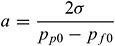 |
A change of any of the quantities on the right-hand side of this equation will result in a new equilibrium radius, but it is the external pressure that plays the dominant role. This does not mean that the internal pressure is unimportant. Quite the contrary. The internal pressure also affects the radius of the particle, but that pressure plays essentially a passive role in the sense that its value is fixed if the external pressure is constant.
However, the smallest variations in the external fluid produces volume pulsations in the particle. By this we mean those motions where every...