Telecom Basics, Second Edition
This guide presents the groundwork of telecom technolgies, network, systems, and call processing.
 TABLE OF CONTENTS
 Signal processing is the method used to modify signals from one form to another. Some of the more common signal processing functions in telecommunications involves the modifying of analog, digital, and radio frequency signals.
Analog signals (continuously varying signals) may be processed by filters, shaping circuits, combiners, and amplifiers to change their shape and modify their content.
Signal filter may remove (band-reject) or allow (band-pass) portions of analog (possibly audio signals) that contain a range of high and low frequencies that are not necessary to transmit. In some cases, filters may be used to combine signals (at different frequencies). These additional signals may be multiple channels or they may be signals that are used for control purposes. If control signals are added to an analog signal that is transmitted, they are usually removed from the audio signal in the receiver by filtering.
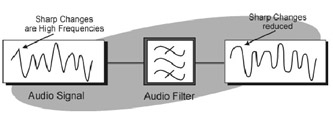
Figure 3.1 shows typical audio signal processing for a communications transmitter. In this example, the audio signal is processed through a filter to remove very high and very low frequency parts (audio band-pass filter). These unwanted frequency parts are possibly noise and other out of audio frequency signals that could distort the desired signal. The high frequencies can be seen as rapid changes in the audio signal. After an audio signal is processed by the audio band-pass filter, the sharp edges of the audio signal (high frequency components) are removed.
A low pass...