Telecom Basics, Second Edition
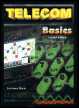
This guide presents the groundwork of telecom technolgies, network, systems, and call processing.
 TABLE OF CONTENTS
 Mobile telephones connect people to the public switched telephone system (PSTN) or to other mobile telephones. Mobile telephone service includes cellular, PCS, specialized and enhanced mobile radio, air-to-ground, marine, and railroad telephone services.
Wireless systems are primarily designed to transfer voice and or data from one point to one or more other points, (multipoint). Many networks make use of some wireless technologies as a transport medium even though we do not consider them to be wireless networks. Examples of wireless networks include cellular, personal communication service, (PCS), paging, wireless data, satellite, and broadcast radio and television.
Wireless systems are composed of radios, radio towers or base stations, interconnection systems, and network management and information systems.
Radios may be fixed in location (such as a television) or may be mobile (such as a cellular telephone). Some radios may only communicate in one direction (typically a receiver) or may have two-way capability. When a single radio has both a transmitter and receiver contained in the same unit, it is called a transceiver.
Radio towers are poles, guided towers, or free standing constructed grids that raise one or more antennas to a height that increases the range of a transmitted signal. Radio towers can vary in height from about 20 feet to more than 300 feet. A single radio tower may host several antenna systems that include paging, microwave, or cellular systems. Radio towers are located strategically around the city to provide radio signal coverage to specific areas. At the base...