We have not discussed the manner in which offices are connected to one another. As Figure 3-36 illustrates, an optical fiber ring with add-drop multiplexers interconnects the central offices so that interoffice traffic can be safely and efficiently transported. The switches have trunk units (TUs) that connect the back side, called the trunk side, of the switch to the wide area network; in this case the optical ring.
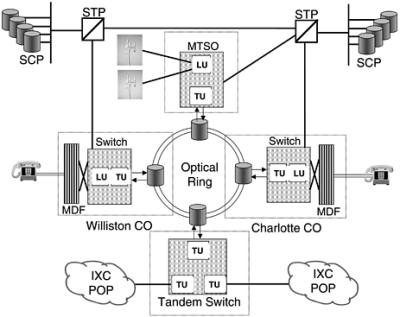 Figure 3-36: Typical network showing fiber ring interconnecting offices
Trunks that interconnect offices have historically been four-wire copper facilities (a pair in each direction). Today they are largely optical, but are still referred to as four-wire because of their two-way nature.
An interesting point about trunks: In the 1960s and early 1970s, most interoffice trunks were analog rather than digital. To signal, they used single frequency tones. Because these trunks did not talk directly to customers, there was no reason to worry about a human voice inadvertently emitting a sound that could be misconstrued as a dialing tone. There was, therefore, no reason to use DTMF dialing instead, trunk signaling was performed using single frequency tones. Specifically, if a switch wished to seize a long-distance trunk, it issued a single-frequency 2,600 Hz tone, which would signal the seizure to take place. Once the trunk seizure had occurred, the dialed digits could be outpulsed and the call would proceed as planned.
In 1972, John Draper, better known by his hacker name Captain Crunch, determined that the toy plastic bosun s...


 TABLE OF CONTENTS