Ten Lectures on Wavelets

This text contains 10 lectures given by the author at the CBMS conference on wavelets organized in June 1990 by the Mathematics Department at the University of Lowell, Massachusetts.
 TABLE OF CONTENTS
 Frames were introduced by Duffin and Schaeffer (1952), in the context of non-harmonic Fourier series (i.e., expansions of functions in L 2([0, 1]) in complex exponentials exp( i ? n x), where ? n ? 2 ? n); they are also reviewed in Young (1980). We review here their definition and some of their properties.
A family of functions ( ? j) j ?J in a Hilbert space  is called a frame if there exist A > 0, B < ? so that, for all f in
  ,
,

We call A and B the frame bounds.
If the two frame bounds are equal, A = B, then I will call the frame a tight frame. In a tight frame we have, for all f  ,
,
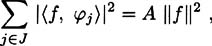
which implies, by the polarization identity, [3]

or

at least in the weak sense. Formula (3.2.2) is very reminiscent of the expansion of f into an orthonormal basis, but it is important to realize that frames, even tight frames, are not orthonormal bases, as illustrated by the following finite-dimensional example.
Take  , e 1 = (0,1),
  ,
, 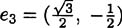 . (See Figure 3.1.) For any v = ( v 1, v 2) in
  , we have
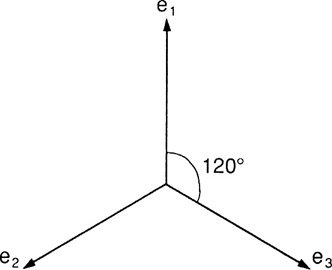
 constitute a tight frame.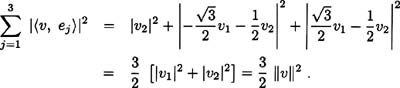
It follows that { e 1, e 2, e 3} is...