Ten Lectures on Wavelets

This text contains 10 lectures given by the author at the CBMS conference on wavelets organized in June 1990 by the Mathematics Department at the University of Lowell, Massachusetts.
 TABLE OF CONTENTS
 All the examples we have seen so far of compactly supported orthonormal wavelet bases are conspicuously non-symmetric, in contrast to the infinitely supported wavelet bases we saw before, such as the Meyer and Battle-Lemari bases. In this chapter we discuss why this asymmetry occurs, what can be done about it, and whether anything should be done about it.
In Chapter 5 we already saw that a multiresolution analysis does not determine ?, ? uniquely. This is again borne out by the following lemma.
If f n( x) = f( x ? n) and  , constitute orthonormal bases of the same subspace E of
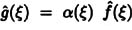
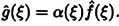
  , then there exists a 2 ?-periodic function ?( ?), with ?( ?) = ? g ? 2 = 1, so that
  .
.
| Proof. |
|
However, we also have the following lemma.
If  is a finite sequence (all but...