Ten Lectures on Wavelets

This text contains 10 lectures given by the author at the CBMS conference on wavelets organized in June 1990 by the Mathematics Department at the University of Lowell, Massachusetts.
 TABLE OF CONTENTS
 This chapter splits naturally into two parts. The first section discusses the role of time-frequency density in wavelet transforms versus windowed Fourier transforms. In particular, for the windowed Fourier transform, orthonormal bases are possible only at the Nyquist density but no such restriction exists for the wavelet case. This leads naturally to the second section, which discusses different possibilities for orthonormal bases in the two cases.
We start with the windowed Fourier case. We mentioned in 3.4.1 that a family of functions  ,
,

cannot be a frame, whatever the choice of g, if ? 0 t 0 > 2 ?. In fact, for any choice of  , one can find
  so that f ? 0 but ? f, g m,n ? = 0 for all
  . If, for instance, ? 0 = 2 ?, t 0 = 2, then such a function f is easy to construct: ? f, g m,n ? = 0 for all
  leads to
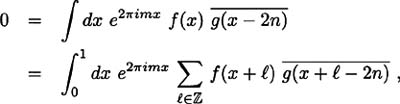
so that it is sufficient to find f ? 0 for which  Define now, for
  Clearly,
  However,
  , which turns into its negative upon the substitution ? = 2 n ? ?? ? 1, and therefore equals zero. The same construction can be used for any other pair ? 0, t 0 with product 4 ?; a...