Transducers and Arrays for Underwater Sound
3.6. Flexural Transducers

3.6. Flexural Transducers

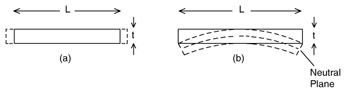
Except for Section 3.5.1 where we discussed the directional flextensional transducer, we have considered only piezoelectric or magnetostrictive drive systems where the motion is extensional as shown in Fig. 3.52a. In this section we will discuss flexural transducers which operate in inextensional bending modes where the neutral plane length does not change as the driver bends as shown in Fig. 3.52b.


Figure 3.52: Extensional (a) and inextensional (b) modes of vibration.

As the bar bends, the part above the neutral plane expands while the part below the neutral plane contracts leading to no net extension. Structures are generally more compliant in bending than in tension which leads to lower resonance frequencies for a given size. The fundamental longitudinal extensional-resonance frequency, f r, and the bending inextensional-resonance frequency, f i, for the free-free bars of Fig. 3.52 are


where c is the bar sound speed and t is the thickness. Both resonance frequencies are approximately the same for a thick bar with t = L/2, but for a thin bar with t = L/20, f i ? f r/10, and the flexural resonance frequency is a decade below the length mode extensional resonance frequency. Thus bender mode transducers are well suited to those low frequency applications where large transducers would be impractical. The excitation of bending modes requires a reversal in the drive system making one portion experience extension while the other experiences contraction about the neutral plane. In this section we will discuss...

UNLIMITED FREE
ACCESS
TO THE WORLD'S BEST IDEAS

SUBMIT
Already a GlobalSpec user? Log in.

This is embarrasing...

An error occurred while processing the form. Please try again in a few minutes.

Customize Your GlobalSpec Experience

Category: Underwater Acoustic Transducers
Finish!
Privacy Policy

This is embarrasing...

An error occurred while processing the form. Please try again in a few minutes.