Transducers and Arrays for Underwater Sound
Naval applications are the main motivation for the development of large, innovative sonar systems. Therefore, the development of large acoustic arrays is closely related to new ship construction, and especially to new submarines since they depend so strongly on acoustics [1, 2]. The main function of active sonar on submarines is searching for surface ships and other submarines, but avoidance of mines and sea mounts, and underwater communications, are also very important functions. Active search requires large projector arrays operating in the 2 10 kHz region for medium range performance, while obstacle avoidance uses smaller, higher-frequency arrays. All submarine applications require transducers capable of withstanding hundreds of pounds per square inch of hydrostatic pressure without significant change in performance. On surface ships active sonar is used mainly for searching for submarines, with transducers similar to those in submarine arrays except for the hydrostatic pressure requirement. Extremely long range active sonar requires lower frequency and higher power (see Fig. 1.13), which leads to many problems in transducer and array design as well as possible environmental effects.
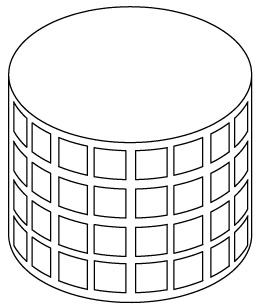
Active sonar arrays often contain hundreds of individual projectors in order to radiate sufficient acoustic power in well-defined directions. The transducers in these arrays are usually mounted on a plane, cylindrical, or spherical surface as shown in Fig. 5.1 and Figs. 1.14 and 1.15, and enclosed behind an acoustic window in the hull of a ship, a submarine, or a towed body.
The transducers...