Transmission Line Transformers, Fourth Edition

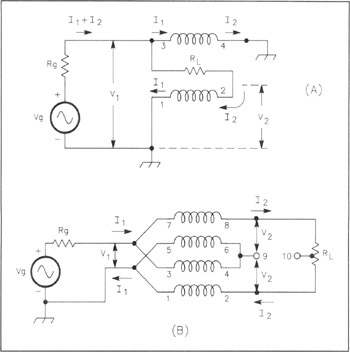
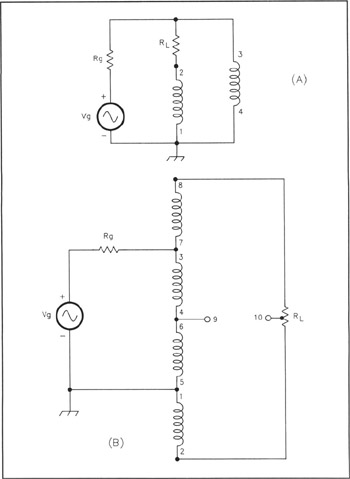
The 1:4 balun, although not as popular as the 1:1 balun, has found considerable use in antenna applications. These include matching folded dipoles to coaxial cables and matching balanced feed lines to unbalanced networks in antenna tuners. Like the 1:1 baluns in Sec 9.2, there are also two forms of the 1:4 balun: (1) the Ruthroff balun, and (2) the Guanella balun. Their high-frequency models are shown in Fig 9-7: Fig 9-8 shows their low-frequency models. But, unlike the 1:1 baluns, both forms of the 1:4 balun have a considerable difference in their performances, depending on whether the load. R L, is "floating" or connected to ground (or a common point) at its mid-point. The analyses of these two conditions are as follows:
R L Floating
The Ruthroff balun (Fig 9-7A) works on the principle that the left side of R L is at +V 1 due to the direct connection to terminal 3 and the right side is at ?V 1 (for a matched transmission line) because of the negative gradient across both windings (see Sec 1.2). Then V out = 2V 1 and the impedance ratio is 1:4. Further, the output is balanced to ground. If the reactances of the windings are much greater than R L