Turbine Steam Path Mechanical Design and Manufacture, Volume IIIa

STATE-LINE EFFICIENCY

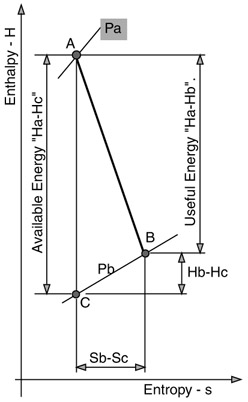
As stated in earlier chapters, in addition to the selection and arrangement of the various components comprising the thermal cycle, a major factor in establishing the heat rate of any installation and/or turbine generator unit is the efficiency with which the thermal potential energy of the steam is converted to kinetic energy and then to mechanical work in the turbine steam path. The efficiency of energy conversion in the turbine steam path is defined as the ratio at which available energy is converted to useful. The most convenient manner of representing this conversion process is to examine the change of steam conditions as the steam expands on the Mollier diagram. The base efficiency of this expansion is referred to as the state-line efficiency, defined as shown in Figure 3-2.

(3.1)

Figure 3-2: Available Energy A C and Useful Energy A B in the Steam Expansion

As the unit operates, any deterioration that occurs within the steam path relates ultimately to the state-line efficiency of that expansion, and it affects the ratio of the available energy of the steam to that converted to useful power within the unit. Therefore, the steam path efficiency can be defined as the ratio of energy per unit weight of working fluid expanding between two pressures that is usefully converted to work in the blade system as compared to the available or isentropic (adiabatic) energy between these same two pressures.

The state-line efficiency for any turbine section is a mean of the individual stage efficiencies, and...

UNLIMITED FREE
ACCESS
TO THE WORLD'S BEST IDEAS

SUBMIT
Already a GlobalSpec user? Log in.

This is embarrasing...

An error occurred while processing the form. Please try again in a few minutes.

Customize Your GlobalSpec Experience

Category: Steam and Gas Turbines
Finish!
Privacy Policy

This is embarrasing...

An error occurred while processing the form. Please try again in a few minutes.