Turbine Steam Path Mechanical Design and Manufacture, Volume IIIa

THE COST OF DAMAGE MECHANISMS

A variety of mechanisms and conditions occur within the steam path that cause its efficiency to modify from the original as-delivered quality. While some of these changes can introduce minor temporary improvements in the efficiency of the unit, possibly at the expense of reliability, the vast majority will introduce a reduction. Even those that produce a temporary improvement, such as the thinning of vane discharge edges, will ultimately cause a degradation as more material is removed and the discharge area increase becomes significant.

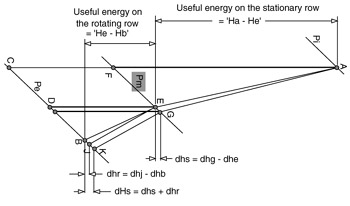
The cost of damage and deterioration is most conveniently considered in terms of the reduction these phenomena cause in the incremental change in unit output, which is a product of the mass flow and the useful energy. Consider that portion of the Mollier Diagram shown in Figure 3-60. This shows the conditions at inlet to and discharge from a stationary and rotating blade row. That is one stage of a total expansion.


Figure 3-60: The Effect of Efficiency Deterioration on the Expansion State Line

The conditions at inlet to the stationary row are pressure Pi and enthalpy Ha. After expansion, at design efficiency, the steam has a final condition at discharge from the stationary row of pressure Pm and an enthalpy of He. The useful energy is then Ha - He. Any condition that occurs within the steam path and reduces the final steam condition from E to G represents a reduction in the useful...

UNLIMITED FREE
ACCESS
TO THE WORLD'S BEST IDEAS

SUBMIT
Already a GlobalSpec user? Log in.

This is embarrasing...

An error occurred while processing the form. Please try again in a few minutes.

Customize Your GlobalSpec Experience

Category: Centrifugal Pumps
Finish!
Privacy Policy

This is embarrasing...

An error occurred while processing the form. Please try again in a few minutes.