Turbine Steam Path Mechanical Design and Manufacture, Volume IIIa

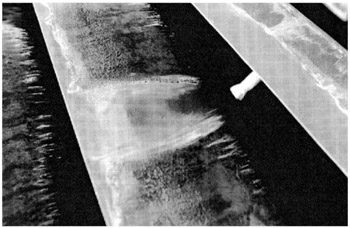
Tie wires are included in many long blades to help dampen the effects of blade vibration by transmitting vibratory motion from impulses developed in one element to another connected by wires and within the same blade group. Unfortunately, these wires will be the source of considerable energy losses due to the drag effect of the wire and the disturbances they introduce into the steam flow in the blade passage. Shown in Figure 3-48 are the deposit patterns behind a strengthening stub in a stationary blade row in this case placed to add security to a single stationary blade vane potion, but the inference of flow disturbance is clear.
The effects of losses due to the tie wires can be determined using the following methods.
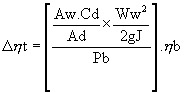
The method of Craig & Cox. This method requires knowledge of the steam properties at the axial location of the wire and provides the following formulation for determining the magnitude of the loss introduced by the wire.
| (3.36) | |
where
| ? ?t | = | the wire energy loss |
| Aw | = | the wire cross sectional area |
| Cd | = | the wire drag coefficient |
| Ad | = | the passage flow area at the wire axial location |
| Ww | = | the steam stream velocity at the wire axial location |
| Pb | = | the work done by the blading |
| ?b | = | the blading efficiency |
The drag coefficient can be taken to be Cd=1.0