2.2 Basic Properties of the 2-D CWT
The main properties of the continuous wavelet transform are conveniently expressed in terms of a linear map W ? from the space of finite energy signals L 2(  2 , d 2
  ) into the space of transforms. We summarize them in three propositions [Mur90,13,15,283].
Proposition 2.2.1. Let the map 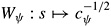 S be defined by
where c ? is the constant given in (2.16) . Then:
(1) W ? conserves the norm of the signal, thus its total energy:
i.e., it is an isometry from the space of signals into the space of transforms. The latter is a closed subspace  ? of L 2( G, dg) , where dg ? a ? 3 d 2
  da d ? is the natural measure on G. Equivalently, the family of wavelets {
  } , with b ? 2 , a > 0 , and 0 ? ? < 2 ?, generates a resolution of the identity:
(2) Since it is an isometry, the map W ? is invertible on its range ? , and the inverse transformation is the adjoint of W ? . This means that the image s( ) may be reconstructed from its wavelet transform S( , a, ?) by the formula:
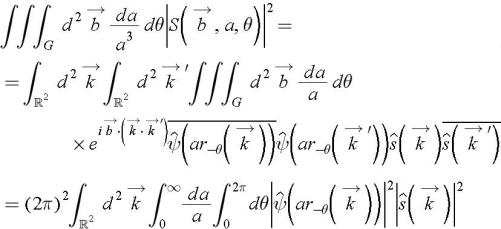
Proof . The relation (2.24) follows from a straightforward calculation:
(the exchange of integrals is justified by Fubini s theorem). Introducing polar coordinates: 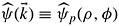 , with ? ?


 TABLE OF CONTENTS