Two-Dimensional Wavelets and their Relatives

2.6: Bridging the Gap: Continuous Wavelet Packets and Fast Algorithms

2.6 Bridging the Gap: Continuous Wavelet Packets and Fast Algorithms

2.6.1 Custom design of dyadic frames

Besides the full discretization described in Section 1.3, and the discrete WT just discussed, there is an intermediate procedure, introduced in [159], under the name of in finitesimal multiresolution analysis. It consists in discretizing the scale variable alone, on an arbitrary sequence of values (not necessarily powers of a fixed ratio). This leads to fast algorithms that could put the CWT on the same footing as the DWT in terms of speed and efficiency, by extending the advantages of the latter to cases where no exact QMF is available. We describe the method in 2-D, the 1-D case (already sketched in Section 1.6.1) being easily derived on this basis. Interested readers should refer to [Tor95] for further details.

Instead of the standard L 2-normalization used in (2.13), it is more convenient to choose the L 1-normalization and use . Note that, for simplicity, we consider here only isotropic wavelets, but the extension to the general case is straightforward (see Section 2.6.3).

Let us start with the L 1-reconstruction formula associated to the CWT in two dimensions:


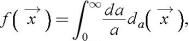
The basic idea behind the proposed construction is now to segment the integral over scales in (2.133) and replace it by a sum over dyadic intervals. This is done first by rewriting the reconstruction formula as


where we have defined the infinitesimal detail


By virtue of Young s convolution inequality, d a ? L 2

UNLIMITED FREE
ACCESS
TO THE WORLD'S BEST IDEAS

SUBMIT
Already a GlobalSpec user? Log in.

This is embarrasing...

An error occurred while processing the form. Please try again in a few minutes.

Customize Your GlobalSpec Experience

Category: Network Bridges
Finish!
Privacy Policy

This is embarrasing...

An error occurred while processing the form. Please try again in a few minutes.