Two-Dimensional Wavelets and their Relatives

Before analyzing the recent approach to fast algorithms (Section 2.6), we have to sketch briefly the 2-D discrete wavelet transform, in its various forms and generalizations.
As mentioned in Chapter 1, a key step in the success of the 1-D discrete WT was the discovery that almost all examples of orthonormal bases of wavelets may be derived from a multiresolution analysis, and furthermore that the whole construction may be translated into the language of digital filters. In the 2-D case, the situation is exactly the same, as we shall see in this section. Further information may be found in [Dau92] or [Mey94].
The simplest approach consists in building a 2-D multiresolution analysis simply by taking the direct (tensor) product of two such structures in 1-D, one for the x direction, one for the y direction. If { V j , j ?
} is a multiresolution analysis of L 2(
), then { (2) V j = V j
V j , j ?
} is a multiresolution analysis of L 2(
2). Writing again (2) V j ? (2) W j = (2) V j + 1, it is easy to see that this 2-D analysis requires one scaling function: ?( x, y) =
( x)
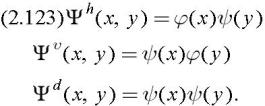
( y), but three wavelets:
As the notation suggests, ? h detects...