UMTS

In a wired telephone network system, the terminal is permanently attached to the network from a fixed point. To make a call, the user has to simply pick up the handset and dial the number of the remote user at any time. The case of a mobile network is more complex for the following reasons:
the user equipment is neither permanently attached to the network nor always localized by the network;
the user equipment is a mobile equipment and therefore, in order to be reachable at any time, it must keep its localization up-to-date;
a geographic area could be covered by several different mobile operator networks and, in this case, a user equipment shall perform the selection of an authorized network. The selected network shall in turn perform admission control on mobile equipments attempting attachment to it.
We can easily see from the above statements that call establishment on a mobile network is not a direct procedure as on a wired network. Indeed, to make the call establishment possible, the following conditions must be fulfilled:
a successful selection of a mobile network;
a successful attachment to the selected network;
updating of the user equipment location.
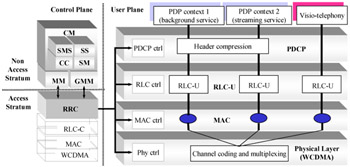
These functions are the responsibility of Non-Access Stratum (NAS) protocols as shown in Figure 8.1.
Signaling between the UE and the network is the responsibility of three protocol sub-layers which constitute the protocol layer 3 of...