UMTS

Chapter 7: UTRA Radio Protocols

7.1. Introduction

This chapter is devoted to the description of protocols implemented in the UTRA/FDD radio interface, whose main role is the set-up, reconfiguration and release of radio bearer services in the Access Stratum. It consists of three protocol layers:

  • the physical layer (layer 1);

  • the data link layer (layer 2);

  • the network layer (layer 3).

Layer 2 is composed of four sub-layers:

  • MAC ( Medium Access Control);

  • RLC ( Radio Link Control);

  • PDCP ( Packet Data Convergence Protocol);

  • BMC ( Broadcast/Multicast Control).

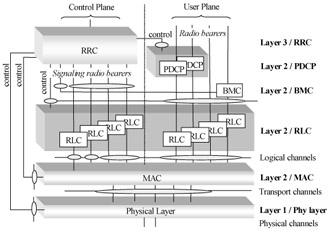
Layer 3 consists of one protocol named RRC ( Radio Resource Control). The other components, MM ( Mobility Management) and CM ( Connection Management) of layer 3 are part of the Non- Access Stratum and are then described in Chapter 8. Figure 7.1 presents the layered architecture of UTRA protocols.


Figure 7.1: Layered architecture of UTRA protocols

We notice in Figure 7.1 that the UTRA protocol stack is divided into control (C) plane and user (U) plane, supporting respectively the signaling messages between the UE and the network and the user data traffic. While MAC and RLC are present in the C- and U-planes, RRC only exists in the C-plane and PDCP and BMC are present in the U-plane exclusively. Signaling messages generated by RRC or submitted to RRC by NAS are transmitted on signaling radio bearers, whereas user data are conveyed over one or several radio bearers with a negotiated QoS that should...

UNLIMITED FREE
ACCESS
TO THE WORLD'S BEST IDEAS

SUBMIT
Already a GlobalSpec user? Log in.

This is embarrasing...

An error occurred while processing the form. Please try again in a few minutes.

Customize Your GlobalSpec Experience

Category: Network Appliances
Finish!
Privacy Policy

This is embarrasing...

An error occurred while processing the form. Please try again in a few minutes.