Multimedia Networking: From Theory to Practice

Chapter 3: Digital Audio Coding

Overview

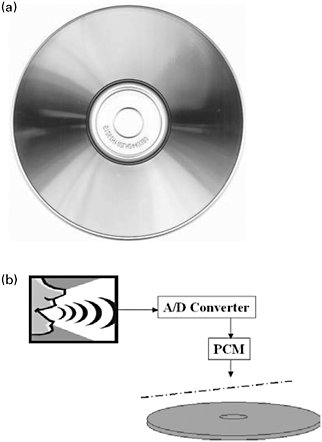
In 1979, Philips and Sony set up a joint task force of engineers to design the new digital audio disk for recording audio music in digital format. After a year of experimentation and discussion, the task force produced the compact disk (CD) standard. The CD (see Figure 3.1(a)), made available on the market in late 1982, remains the standard physical medium for commercial audio recordings [1]. An audio CD consists of one or more stereo tracks stored using 16-bit pulse code modulation (PCM) coding at a sampling rate of 44.1 kHz (see Figure 3.1(b)). Standard compact disks have a diameter of 120 mm and can hold approximately 60 80 minutes of audio. From its origins as a music format, CD has grown to encompass other applications, e.g., the CD-ROM (read-only memory) and CD-R/W. Compact disks are now widely used as a data storage medium for computers and consumer electronics.


Figure 3.1: (a) The first compact disk (CD) was available on the market in late 1982. (b) An audio CD consists of one or more stereo tracks stored using 16-bit PCM coding at a sampling rate of 44.1 kHz.

The original capacity requirement for recording digital audio is about 635 megabytes (MB) per hour or 1.411 Mbps, i.e.,


The famous computer-based waveform audio storage format, WAV (waveform audio format, with extension *.wav) [2], was originally developed by Microsoft and IBM. These audio files are usually uncompressed (i.e., lossless) but can act as a wrapper for various audio compression codecs, such as...

UNLIMITED FREE
ACCESS
TO THE WORLD'S BEST IDEAS

SUBMIT
Already a GlobalSpec user? Log in.

This is embarrasing...

An error occurred while processing the form. Please try again in a few minutes.

Customize Your GlobalSpec Experience

Category: Video and Audio Software
Finish!
Privacy Policy

This is embarrasing...

An error occurred while processing the form. Please try again in a few minutes.