Multimedia Networking: From Theory to Practice

The Windows Media 9 Series includes a variety of audio and video codecs, which are key components supporting the authoring and playback of digital media in Microsoft products. The Windows Media Video 9 (WMV-9) codec is the latest video codec in this suite and is based on technology that can achieve state-of-the-art compressed video quality from very low bitrates (such as 160 120 at 10 kbps for modem applications) through very high bitrates (1280 720 or 1920 1080 at 4 8 Mbps for high-definition video and even higher bitrates for mastering) [12].
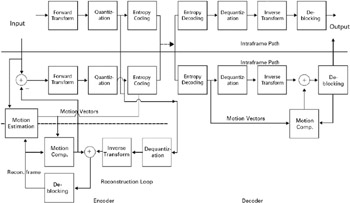
The internal color format for WMV-9 is 8-bit 4 : 2 : 0. As seen in Figure 5.44, the WMV-9 codec, like most other standardized video codecs, uses a block-based motion-compensation and spatial transform scheme. The motion-compensated frame difference, or residual error, is transformed using a linear energy-compacting transform and then quantized and entropy coded. On the decoder side, the quantized transform coefficients are entropy decoded, dequantized, and inverse-transformed to produce an approximation to the residual error, which is then added to the motion-compensated prediction to generate the reconstruction.
As for most other standardized video codecs, WMV-9 has intra (I), predicted (P), and bidirectionally predicted (B) frames for both progressive and interlaced sequences. The B-frames in WMV-9 are not used as a...