Urban Transportation Systems: Choices for Communities
Automobiles dominate the transportation picture today, both inside and outside cities. Cars are the blessing and the curse of American communities. They have given an unprecedented level of mobility to the larger part of this society (albeit not everybody), but they also threaten to choke our center cities, and they consume resources at a disproportionate rate. Mass transit accounts for only a few percentage points of all daily travel in the United States; it almost falls within the range of statistical error, and, thus, could theoretically be ignored in any general transportation discussion. Many Americans do exactly that, but that is not the attitude taken in this book. Nevertheless, we live in a country that runs on rubber tires, for better or for worse.
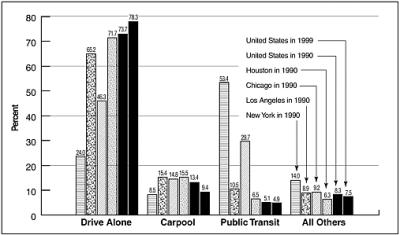
Commuting to work may no longer be the largest single trip purpose in the United States, but it is undoubtedly the most critical one. On any given day, as shown in Fig. 5.1, seven-eighths of these movements (87 percent) are accommodated by some type of individual motor vehicle overwhelmingly cars carrying only one person. Among the large cities, only New York has more commuters on mass transit than in cars; and the younger a city is, the more closely its modal breakdown is likely to approach that of the national averages.
The ubiquitous and persistent presence of...