Wireless Positioning Technologies and Applications

Demodulation and data recovery of a direct sequence spread spectrum signal involves several operations:
Carrier synchronization;
Chip synchronization;
Coarse despreading signal acquisition;
Code synchronization code tracking;
Data demodulation.
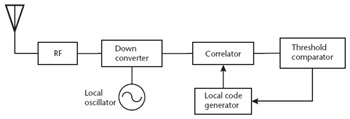
Signal acquisition is described below. Since there are several strategies and system configurations that can be used for acquisition, this explanation is based on the block diagram in Figure 3.9. We make the following assumptions:
The spreading code period is relatively short.
Demodulation is coherent, that is, the local oscillator is phased locked to the carrier, or the IF, if downconversion is done in stages.
Transmitter and receiver chip rates are equal.
The code is an m-sequence, generated in a linear feedback shift register.
No data is transmitted during acquisition.
There is no noise or interference.
Code modulation is BPSK.
The consequences of not adhering to all of these assumptions will be discussed later.
In order to detect data in a spread spectrum transmission, the signal first has to be despread, that is, the spreading code must be removed. To do this, the locally produced spreading code must be phase aligned with the code of the incoming signal. In Figure 3.9, the correlator receives the downconverted baseband spreading code and the locally generated code. During normal communication, it may not be important to know the time when the local code generator begins its sequence, but this time must be known for distance measurement. Figure 3.10 shows the output of the correlator as...