Wireless Positioning Technologies and Applications

Chapter 5: Multicarrier Phase Measurement

Up to now we have seen methods of distance measurement that depend on discrete time unit counting to determine time of flight of a radio signal between transmitter and receiver. Both the spread spectrum sequence alignment method and time transfer procedure achieve higher resolution of distance through greater clock rates and signal bandwidth. In both of them the measuring stick is the system clock and the graduations are time base pulses or fractions of them. In this chapter distance is measured by measuring phase differences of RF carriers and in general we deal in the frequency domain as compared to the time domain and the realm of pulse widths and rise times. Still the basic principles take hold for example, higher resolution is gained by spectrum expansion. Multicarrier distance measuring techniques discussed here are applied using frequency hoping spread spectrum and OFDM transmissions.

5.1 Principle of Multicarrier Phase Measurement

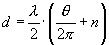
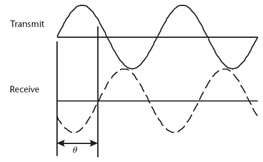
The phase difference between a received CW carrier, or a modulated tone, and a reference signal, can be used to measure distance, as demonstrated in Figure 5.1. An interrogator transmits an uninterrupted tone. The responder phase locks a local oscillator to the incoming tone and retransmits it. The interrogator measures the phase lag of the received tone compared to the reference tone and calculates the one way distance as:

(5.1)

Figure 5.1: Single carrier distance measurement.

where ? is the tone wavelength, ? is the phase, and n is an integer. Since the range of the phase measurement is...

UNLIMITED FREE
ACCESS
TO THE WORLD'S BEST IDEAS

SUBMIT
Already a GlobalSpec user? Log in.

This is embarrasing...

An error occurred while processing the form. Please try again in a few minutes.

Customize Your GlobalSpec Experience

Category: RF Transceivers
Finish!
Privacy Policy

This is embarrasing...

An error occurred while processing the form. Please try again in a few minutes.