Wireless Positioning Technologies and Applications

The most straightforward method of wireless distance measuring uses synchronized clocks in the initiator and the target. Only a one-way ranging ranging link is required. The target transmits a recognizable event with a time stamp and the initiator receiver notes the time of arrival. The time of flight is the receiver time of arrival of the event minus the time stamp. Virtually none of the applications that are considered in this book use synchronized clocks on all terminals, although multilateral networks used for location do have them on the fixed terminals. Oneway time transfer to synchronize clocks is not possible when the distance between the terminals is unknown. However, using two-way time transfer methods both clock time difference and propagation delay can be estimated.
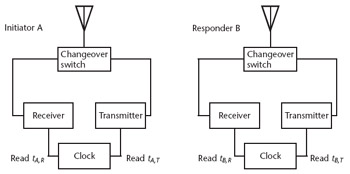
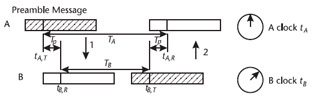
A half duplex two-way ranging method is described next [1, 2]. Figure 4.1 is a block diagram of the system whose transmission frames and timing are illustrated in Figure 4.2. This description is a simplified one since it makes the following assumptions:
The time bases of both terminals have the same rate with no drift.
Speed of propagation is the same in both directions.
No delays other than that due to wave propagation in space.
No multipath interference.
A and B are transceivers, each with an independent clock. The object is to find the time difference between the two clocks at an instant in time,
| (4.1) | |
and the time of...