Fluorinated Ionomers

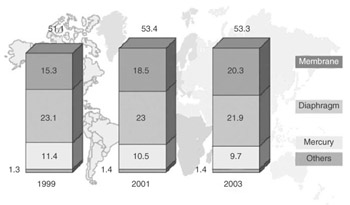
By far the largest application for fluorinated ionomers is as a separator in chlor-alkali cells. Figure 8.1 shows the worldwide chlorine capacity for the membrane process, as well as for the older technologies, for the years 1999, 2001 and 2003. There was a significant increase in capacity in the membrane process and a reduction in the other technologies. In 2003, the worldwide capacity by the membrane process was 20.3 million tons per year.
To convert this capacity into membrane terms, assume a current density of 5 kA/m 2 and a current efficiency of 95%. Under these conditions, 1 m 2 of active membrane area produces 151 kg of chlorine per day or 55 t per year. The active membrane area installed worldwide for chlorine production in 2003 was therefore about 370,000 m 2. The total area is slightly larger because of the inactive membrane area under the gaskets. At an average selling price (year 2005) of $850/m 2, the value of these membranes is about $320 million. With an average service life of slightly more than 3 years, the membrane replacement business is therefore about $100 million per year. An additional $20 million worth of membranes may be required each year for new capacity.
In terms of geographic distribution (Figs 8.2 and 8.3), chlorine production in the older industrial countries was either stagnant (Western Europe) or declined (North America),...