Fluorinated Ionomers

Chapter 10: Heat Sealing and Repair

Overview

While melt fabrication of fluorinated ionomers is typically done in the precursor form, the finished product in the hydrogen ion form has enough melt flow to permit heat sealing and repair. Impulse heating is used for heat sealing, because at the required temperatures the ionomers undergo slow thermal degradation. Ionomers in the tetra alkyl ammonium form have a much lower melting point than ionomers containing inorganic cations. The tetra butyl ammonium form is particularly easy to heat seal [1].

Commercial heat-sealing equipment is available from Vertrod and Quiver in Milan, Italy. Quivers offers a complete system for membrane repair, including equipment to check large sheets of membranes for leaks, automated patching equipment and patches made of Nafion attached to a Kapton release sheet.

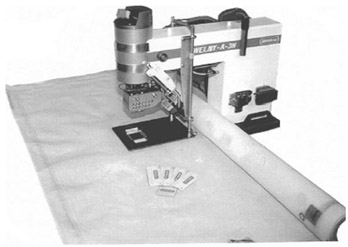
Figures 10.1 through 10.3 show a defect in a large sheet of membrane being repaired. Most of the sheet is rolled up under the support arm of the heat sealer. Five precut repair patches can be seen in the foreground.


Figure 10.1: Quiver heat sealer applying a patch to a membrane (courtesy Quiver Ltd., Milan, Italy).

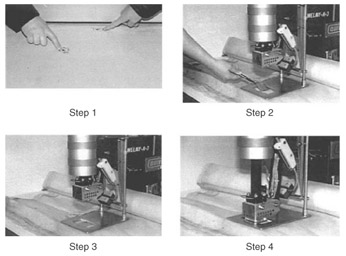
Figure 10.2: The first steps of the repair procedure (courtesy Quiver Ltd., Milan, Italy). Step 1 The spots to be repaired are identified and marked. Step 2 The patch is placed inside the centering plate. Step 3 The operator pushes the two start buttons. Step 4 The welding cycle starts.

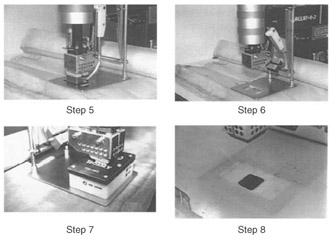
Figure 10.3: The final steps of the repair procedure (courtesy Quiver Ltd., Milan, Italy). Step 5 ...

UNLIMITED FREE
ACCESS
TO THE WORLD'S BEST IDEAS

SUBMIT
Already a GlobalSpec user? Log in.

This is embarrasing...

An error occurred while processing the form. Please try again in a few minutes.

Customize Your GlobalSpec Experience

Category: Seal Repair Services
Finish!
Privacy Policy

This is embarrasing...

An error occurred while processing the form. Please try again in a few minutes.