
ISO Containers Information
ISO or intermodal containers are used for the intermodal transport of freight. They are manufactured according to specifications from the International Orginization for Standardization (ISO) and are suitable for multiple transportation methods such as truck, rail, or ship. These regulations define a shipping container that meets size, strength, and durability requirements. The basis of these regulations is to guarantee that the container can withstand extreme environments endured during transport as well as possess the structural integrity needed to be lifted by cranes or other heavy equipment.
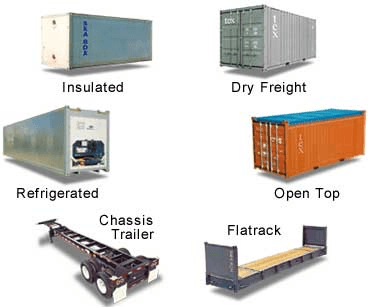
Image Credit: ISOCONTAINER.com
Container safety certificate (CSC)
ISO containers include a container safety certificate (CSC) issued by the manufacturer that must be renewed every 30 months by a certified inspector. If necessary, an approved continuous examination program (ACEP) can be used in place of this procedure.

Image Credit: ContainersforSale
Selection Criteria
When selecting an ISO container the most important criteria to consider are the type and dimensions of the container. It is also important to understand the codes used to mark and identify the container as well as features that may be available.
Types of ISO Containers
There are several basic types of ISO containers including flat racks, open-top, dry freight, insulated, reefer, and tank containers.
Flat racks and platforms are ISO containers that are used to transport heavy machinery. They do not have side walls, but may have end bulkheads and are often collapsible.

Image Credit: flatrackcontainer.org
Open-top containers are shaped like a box and loaded from either the top or end. They are designed to carry heavy, tall, or hard to load materials such as coal or grain.
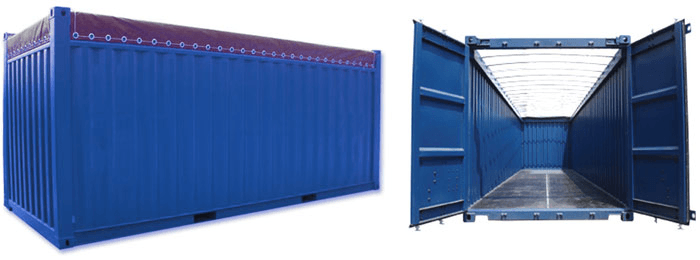
Image Credit: Shipping Containers24
Dry freight or cube containers are front loaded, completely enclosed and suitable for general-purpose transportation.

Image Credit: BakerCorp
Insulated or thermal containers are suitable for transporting chilled and frozen goods, as well as temperature-sensitive materials and products. They have insulated walls, but are not refrigerated.
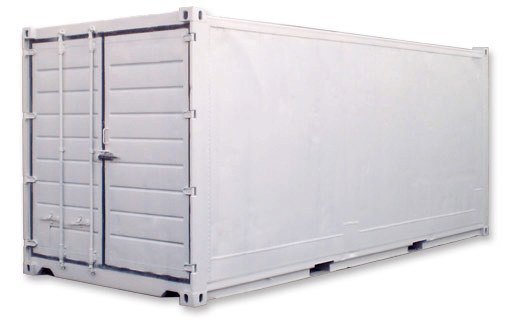
Image Credit: Coastal Container
Reefer or refrigeration containers are temperature controlled containers that have an integral refrigeration unit. They are used to ship and transport perishables or other items that require a temperature controlled atmosphere.

Image Credit: Cold Box
Tank containers are built to the same standard dimensions as other ISO containers, but are cylindrical vessels mounted in a rectangular steel framework. Typically, these containers are used to transport liquid or bulk materials.

Image Credit: Tank Services Inc.
Dimensions
ISO containers are the ideal shipping container as their dimensions are regulated by the International Standards Organization (ISO). These regulations allow ISO containers to use space as efficiently as possible regardless of the method of transport.
Height
Standard ISO containers measure 8 ft. 6 in., but they are available in several discrete heights measuring from 4 ft. to 9 ft. 6 in. Containers that measure 9 ft. 6 in. tall are called extended height or high cube containers while 4 ft. and 4 ft. 6 in. containers may be referenced as half height containers.
Width
The majority of all ISO containers measure 8 ft. or 2,438 mm wide. ISO Containers that exceed this dimension are grouped into two other size ranges. Alpha characters C, D, E, and F identify containers that are greater than 2,438 mm, but less than 2,500 mm. Containers that exceed 2,500 mm are referenced by L, M, N, and P.
Length
The most common lengths are 20 and 40 ft. Other lengths include 24, 28, 44, 45, 46, 53, and 56 ft.
Coding, Identifying, and Marking
The standard used to identify intermodal (shipping) containers is ISO 6346:1995. This standardized identification system is used to give each container a unique marking. The code can be further broken up into three parts an ISO 6346 (BIC) code, a size and type code, and additional optional markings.
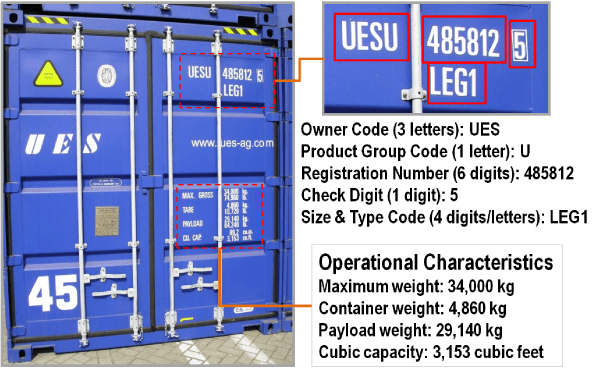
Image Credit: The Geography of Transport Systems
ISO 6346 (BIC) Codes
The ISO 6346 (BIC) code identifies the owner of the container, the product group, and contains a unique serial number and check digit that identifies the container. The company code or owner code is the first three alpha characters. This abbreviation is registered with an international organization, Bureau International des Containers et du Transport Intermodal, ensuring every company has a unique code. The product group U is used for all intermodal containers while J is used for equipment attachments and Z designates chassis or frames used to carry intermodal containers. The serial number identifies an individual container and is cross referenced with the check digit.

Image Credit: ShippingContainers24
Size and Type Codes
The size and type code is a four character code that represents the length, height, width, and type of container. The first character specifies the length, the second the height and width, and the last two characters specify the type of container as shown in the table below.
| Code | Group code | Type | Type code | Principal characteristics |
| G | GP | Unventilated general purpose container | G0 | Openings at one or both ends |
| G1 | Vents in upper part of cargo space | |||
| G2 | Openings at one or both end(s), plus "full" openings at one or both sides | |||
| G3 | Openings at one or both end(s), plus "partial" openings at one or both sides | |||
| G4 | Spare | |||
| G5 | Spare | |||
| G6 | Spare | |||
| G7 | Spare | |||
| G8 | Spare | |||
| G9 | Spare | |||
| V | VH | General purpose containers with ventilation | V0 | Non-mechanical ventilation at the lower and upper parts of the cargo space |
| V1 | Spare | |||
| V2 | Mechanical ventilation installed in the container | |||
| V3 | Spare | |||
| V4 | Mechanical ventilation installed outside the container | |||
| V5 | Spare | |||
| V6 | Spare | |||
| V7 | Spare | |||
| V8 | Spare | |||
| V9 | Spare | |||
| B | BU | Dry bulk containers, non-pressure-resistant | B0 | Closed |
| B1 | Airtight | |||
| BK | Pressurized | B2 | Spare | |
| B3 | Horizontal discharge, test pressure 150 kPa | |||
| B4 | Horizontal discharge, test pressure 265 kPa | |||
| B5 | Tipping discharge, test pressure 150 kPa | |||
| B6 | Tipping discharge, test pressure 265 kPa | |||
| B7 | Spare | |||
| B8 | Spare | |||
| B9 | Spare | |||
| S | SN | Named cargo containers | S0 | Livestock container |
| S1 | Automobile container | |||
| S2 | Living fish container | |||
| S3 | Spare | |||
| S4 | Spare | |||
| S5 | Spare | |||
| S6 | Spare | |||
| S7 | Spare | |||
| S8 | Spare | |||
| S9 | Spare | |||
| R | RE | Thermal containers - refrigerated - refrigerated and heated - self powered refrigerated/heated |
R0 | Mechanically refrigerated |
| RT | R1 | Mechanically refrigerated and heated | ||
| RS | R2 | Mechanically refrigerated | ||
| R3 | Mechanically refrigerated and heated | |||
| R4 | Spare | |||
| R5 | Spare | |||
| R6 | Spare | |||
| R7 | Spare | |||
| R8 | Spare | |||
| R9 | Spare | |||
| H | HR | Thermal containers - refrigerated and/or heated with removable equipment |
H0 | Refrigerated and/or heated with removable equipment located externally, coefficient of heat transfer K=0.4 W/(m2.K) |
| H1 | Refrigerated and/or heated with removable equipment located internally | |||
| H2 | Refrigerated and/or heated with removable equipment located externally, coefficient of heat transfer K=0.7 W/(m2.K) | |||
| H3 | Spare | |||
| H4 | Spare | |||
| HI | H5 | Insulated, coefficient of heat transfer K=0.4 W/(m2.K) | ||
| H6 | Insulated, coefficient of heat transfer K=0.7 W/(m2.K) | |||
| H7 | Spare | |||
| H8 | Spare | |||
| H9 | Spare | |||
| U | UT | Open-top containers | U0 | Opening(s) at one or both end(s) |
| U1 | Opening(s) at one or both end(s) plus removable roof in end frame | |||
| U2 | Opening(s) at one of both end(s) plus opening(s) on one or both sides | |||
| U3 | Opening(s) at one or both end(s) plus opening(s) on one or both sides plus removable top members | |||
| U4 | Opening(s) at one or both end(s) plus opening(s) on one side plus full openings on the other side | |||
| U5 | Full, solid side and end walls (no doors) | |||
| U6 | Spare | |||
| U7 | Spare | |||
| U8 | Spare | |||
| U9 | Spare | |||
| P | PL | Platform (container) - platform based on containers with incomplete superstructure - fixed - folding - platform based containers with complete superstructure |
P0 | Platform |
| PF | P1 | Platform with two complete, fixed end walls | ||
| P2 | Platform with fixed posts, either free-standing or with removable top members | |||
| PC | P3 | Platform with folding complete end walls | ||
| P4 | Platform with folding posts, either free-standing or with removable top members | |||
| PS | P5 | Platform, open at the top and ends (skeletal) | ||
| P6 | Spare | |||
| P7 | Spare | |||
| P8 | Spare | |||
| P9 | Spare | |||
| T | TN | Tank container for non-dangerous liquids | T0 | Minimum pressure 45 kPa |
| T1 | Minimum pressure 150 kPa | |||
| T2 | Minimum pressure 265 kPa | |||
| TD | Tank container for dangerous liquids | T3 | Minimum pressure 150 kPa | |
| T4 | Minimum pressure 265 kPa | |||
| T5 | Minimum pressure 400 kPa | |||
| T6 | Minimum pressure 600 kPa | |||
| TG | Tank container for gases | T7 | Minimum pressure 910 kPa | |
| T8 | Minimum pressure 2 200 kPa | |||
| T9 | Minimum pressure (yet to be assigned) | |||
| A | AS | Air/surface containers | A0 | |
Image Credit: SMDG
Features
 ISO containers are available with many special features. Some containers are airtight or stackable. Others are designed for storing and moving flammable, corrosive, explosive, or other hazardous materials. Containers that are shielded against electromagnetic interference (EMI) and radio frequency interference (RFI) are often used in the transportation of electric and electronic products. Vented ISO containers with ducts along the side panels and top and bottom rails are suitable for replacing warm, moist air with colder, ambient air. Often, desiccants such as silica-gel are used in the transportation of high-moisture products such as coffee beans or other perishables.
Resources
The Geography of Transport Systems - Container Identification System
Bureau International des Containers - Presentation of the BIC Codes
International Standards Organization - Freight Containers
Container Alliance - Why People Buy ISO Containers