Process Integration

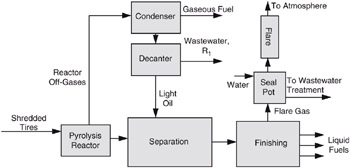
4.1 A processing facility converts scrap tires into fuel via pyrolysis (El-Halwagi 1997). Figure 4-30 is a simplified block flow diagram of the process. The discarded tires are fed to a high-temperature reactor where heat breaks down the hydrocarbon content of the tires into oils and gaseous fuels. The oils are further processed and separated to yield transportation fuels. The reactor off-gases are cooled to condense light oils. The condensate is decanted into two layers: organic and aqueous. The organic layer is mixed with the liquid products of the reactor. The aqueous layer is a wastewater stream whose organic content must be reduced prior to discharge. The primary pollutant in the wastewater is a heavy hydrocarbon. The data for the wastewater stream are given in Table 4-6.
FIGURE 4-30: A SIMPLIFIED BLOCK FLOW DIAGRAM OF A TIRE-TO-FUEL PROCESS (EL-HALWAGI 1997)
| Stream | Description | Flowrate (kg/s) G i | Supply composition (ppmw) | Target composition (ppmw) |
|---|---|---|---|---|
| R 1 | Aqueous layer from decanter | 0.2 | 500 | 50 |
A process lean-stream and three external MSAs are considered for removing the pollutant. The process lean-stream is a flare gas (a gaseous stream fed to the flare) which can be used as a process stripping agent. To prevent the back-propagation of fire from the flare, a seal pot is used. An aqueous stream is passed through the seal pot to form a buffer zone between the fire and the source of...