Process Integration

Chapters Twelve and Thriteen presented mathematical techniques for direct recycle and for mass exchange networks. As mentioned in Chapter Five, mass integration is a much broader concept than direct recycle and mass exchange. Mass integration is a holistic and systematic methodology that provides a fundamental understanding of the global flow of mass within the process and employs this understanding in identifying performance targets and optimizing the allocation, separation, and generation of streams and species. In order to develop detailed mass-integration strategies, Chapter Five presented visualization tools that provide insights and guide the development of solution strategies. The purpose of this chapter is to provide mathematical-programming techniques that can determine cost effective mass integration strategies.
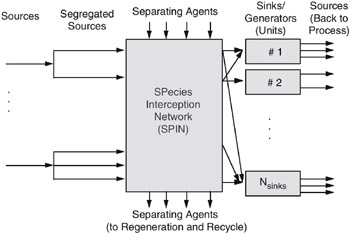
As mentioned in Chapter Five, the process flowsheet can be described through a source-interception sink representation (e.g. El-Halwagi and Spriggs 1998; El-Halwagi et al., 1996) as shown in Figure 14-1. For each targeted species, there are sources (streams that carry the species) and process sinks (units that can accept the species). Streams leaving the sinks become, in turn, sources. Therefore, sinks are also generators of the targeted species. Each sink/generator may be manipulated via design and/or operating changes to affect the flowrate and composition of what each sink/generator accepts and discharges. In order to adjust the flows, compositions, and properties of the sources, a species interception network (SPIN) is used. It may be composed of interception devices (e.g., separators) that employ mass and energy separating agents.