Properties of Silicon Germanium and SiGe: Carbon

Chapter 1: Introduction

1.1 Strain-Induced Morphological Evolution of SiGe Thin Films

D.E. Jesson
March 1999

A INTRODUCTION

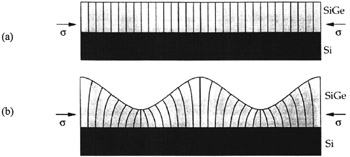
Whenever a SiGe alloy layer is deposited on Si it is subject to a compressive misfit stress a as illustrated in FIGURE 1(a). The accompanying misfit strain can be as large as 4% for a pure Ge film. Hence, strong driving forces exist to relieve the elastic energy stored in the layer. This can be achieved by the introduction of misfit dislocations [1]. However, for alloy compositions with a Ge component greater than about 10%, dislocation introduction is usually preceded by the formation of coherently strained islands [2]. The physical reason for dislocation-free island formation or self-assembly can be understood from the Asaro Tiller Grinfeld (ATG) instability [3,4] which has been derived in the context of strained layer epitaxy by Srolovitz [5].


Figure 1: (a) Cross-sectional schematic of a SiGe alloy under compressive misfit stress ?. (b) A sinusoidal perturbation is introduced at the surface.

Consider a sinusoidal perturbation at the surface of the planar strained layer as illustrated in FIGURE 1(b). The perturbation enables lattice planes which are compressed in the bulk of the film to relax toward the peaks which reduces the elastic energy. However, this is opposed by the additional surface energy created. Balancing these energies gives the well known condition for the minimum wavelength for which the perturbation is stable [3 5]


Here ? is the surface energy, ?. the shear modulus and ? Poisson's ratio. Beyond ? c it...

UNLIMITED FREE
ACCESS
TO THE WORLD'S BEST IDEAS

SUBMIT
Already a GlobalSpec user? Log in.

This is embarrasing...

An error occurred while processing the form. Please try again in a few minutes.

Customize Your GlobalSpec Experience

Category: Burnishing and Peening Machines
Finish!
Privacy Policy

This is embarrasing...

An error occurred while processing the form. Please try again in a few minutes.