Valve Amplifiers, Third Edition

Chapter 2: Basic Building Blocks

In this chapter we will look mainly at the triode valve, how to choose operating conditions, and what effect these choices have on the AC performance of the stage. The analysis will use a combination of graphical and algebraic techniques, which has the advantage of being quick to use, and the results of the theory agree well with practice. This last point might seem to be an obvious requirement, but it is one that is sometimes overlooked.

The Common Cathode Triode Amplifier

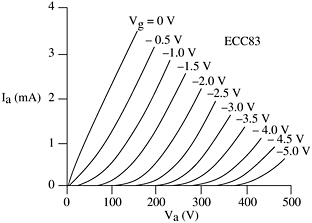
The most common use of a valve is amplification. Therefore we need to know how to configure and bias the valve so that it can amplify in a linear manner and minimize distortion. We will begin by investigating the anode characteristics of an ECC83/12AX7. See Fig. 2.1.


Fig. 2.1: Triode anode characteristics

The anode characteristics are the most useful set of curves for a valve, and the plot shows anode current I a against anode voltage V a, for differing values of grid to cathode voltage ( V g k). The first point to note is that valves operate at high voltages (typically a factor of ten greater than transistor circuits), and quite low currents. The second point is that if there is no bias voltage ( V g k=0), then a large anode current flows. This is known as the space-charge limited condition, and means that the flow of current is limited only by the number of electrons that can...

UNLIMITED FREE
ACCESS
TO THE WORLD'S BEST IDEAS

SUBMIT
Already a GlobalSpec user? Log in.

This is embarrasing...

An error occurred while processing the form. Please try again in a few minutes.

Customize Your GlobalSpec Experience

Category: Diodes
Finish!
Privacy Policy

This is embarrasing...

An error occurred while processing the form. Please try again in a few minutes.