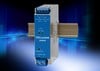
A power supply is a device that converts one voltage to another, more convenient voltage, whilst delivering power.
Valve amplifiers need a DC High Tension (HT) supply and one or more heater, or Low Tension (LT) supplies, which may be AC or DC. Often, the supplies for the pre-amplifier and power amplifier will be derived from the same power supply, which is frequently integral to the power amplifier, but this need not be so.
In this chapter, we will identify the major blocks of a power supply, see how to design them, then design a pair of complete supplies.
The Major Blocks
There are two fundamental types of power supply, linear and switchers. See Fig. 5.1.
 Fig. 5.1: Comparison of linear and switcher power supplies
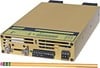
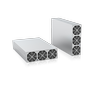
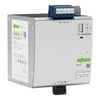
 In a switcher, the AC mains input is rectified, switched at a high frequency, typically >50 kHz, transformed, rectified, and smoothed; regulation is part of the switching element. Switchers are small, light and efficient. Their design is highly specialized, and early designs generated copious RF noise, but designs conforming to modern Electro-Magnetic Interference (EMI) standards are surprisingly quiet, and can be useful for heater supplies.
By contrast, a linear supply transforms the 50 Hz AC mains directly, requiring a bulky mains transformer. This is then rectified by valves or semiconductors, smoothed by large capacitors, and possibly even larger inductors, and then regulated if necessary. Linear supplies are heavy, inefficient, easily designed, but low noise. Valve amplifiers use lots of them, so we had...
Copyright Morgan Jones 2003 under license agreement with Books24x7


 TABLE OF CONTENTS