Valve Amplifiers, Third Edition

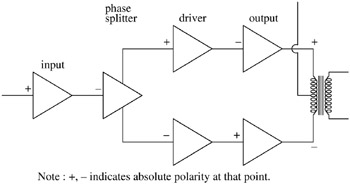
Having looked at the problems of the output stage, we can now consider the support circuitry in detail. The output stage is insufficiently sensitive to be driven directly from a pre-amplifier, so it needs additional gain. If it is push pull, it will need a phase splitter. Since linearity is unlikely to be ideal, we will probably need global negative feedback, which will further reduce gain, and this will need to be restored. A complete system might therefore comprise an input stage, a phase splitter, a driver stage, and the output stage. See Fig. 6.13.
Although a Class A output stage is a constant resistive load, a Class AB2 output stage heavily loads the driver stage when drawing grid current, so its driver stage would need very low output resistance and be able to source significant current to drive this load without distortion.
Unlike the output stage, and possibly the driver stage, the remainder of the stages in a power amplifier will be loaded by predictable resistive loads. It is therefore possible, and desirable, to design these stages with great care in order that they should not degrade the performance of the entire amplifier. We will mainly consider push pull amplifiers, since they make up the majority of designs, although their design principles may perfectly well be applied to single-ended amplifiers.