The task of a power amplifier is to provide a fixed level of gain to a processed signal and deliver power into a load such as a loudspeaker. It should do this without introducing spurious signals, such as hum, noise, oscillation, or audible distortion, whilst driving a wide range of loads. Additionally, it should be tolerant of abuse, such as open or short circuits. It will be appreciated that this is not a trivial objective, and will therefore require careful design and execution if it is to be achieved.
The determining factor is the output stage. The solution adopted here dictates the topology of the remainder of the amplifier, so we will begin by investigating the output stage.
The Output Stage
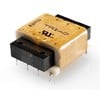
Typical audio valves are high impedance devices and can swing hundreds of volts, but deliver only tens of milliamps of current. By contrast, a loudspeaker of typically 4 8 ? nominal impedance requires tens of volts and amps of current. The obvious solution to this problem is to employ an output transformer to match the loudspeaker load to the output valve or valves.
This is where the problems start. As was hinted earlier, transformers are rather less than perfect, and the ultimate quality of a valve amplifier is limited by the quality of its output transformer. Despite this, the transformer coupled output stage is a good engineering solution, and is used in most valve amplifiers (see later for Output Transformer-Less designs).
Valves designed specifically for audio use...
Copyright Morgan Jones 2003 under license agreement with Books24x7


 TABLE OF CONTENTS