Valve Amplifiers, Third Edition

The driver stage is always preceded by the phase splitter, and traditionally the two stages have been combined although as we shall see, this is not always a good idea. Design of the phase splitter is crucial to the success of a push pull amplifier, so we will look at this in detail.
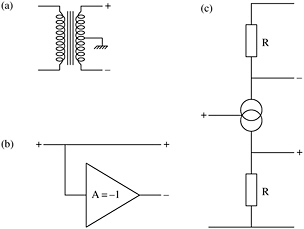
The phase splitter converts a single-ended signal into two signals of equal amplitude, but with one of inverted polarity. There are three fundamental ways of achieving this goal. See Fig. 6.15.
We use a centre-tapped transformer in the same way that we use an output transformer to provide inverted and non-inverted signals. All of the previous considerations about transformers apply with a vengeance because of the comparatively high impedances involved, and the technique is not widely used, even though balance is near perfect under all conditions. See Fig. 6.15a.
We have two outputs, one is the original signal, and the other is simply the input passed through an inverter. See Fig. 6.15b.
A single device controls the flow of current in two resistors, one of which is connected to ground, and the other to HT. Increased current causes the instantaneous voltage dropped across each resistor to rise, so at any instant the voltage relative to ground is falling at one output, whilst the other is rising. See Fig. 6.15c.
All of the phase splitters employing the second method are based on the differential pair, whilst the third method...