MATLAB Recipes for Earth Sciences

Introducing methods of data analysis in geosciences using MATLAB, this book includes a brief description of each method and numerous examples demonstrating how MATLAB can be used on data sets from earth sciences.
 TABLE OF CONTENTS
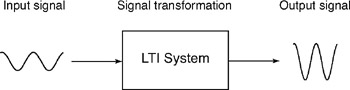
 Signal processing refers to techniques for manipulating a signal to minimize the effects of noise, to correct all kinds of unwanted distortions or to separate various components of interest. Most signal processing algorithms include the design and realization of filters. A filter can be described as a system that transforms signals. System theory provides the mathematical background for filter design and realization. A filter as a system has an input and an output, where the output signal y( t) is modified with respect to the input signal x( t) (Fig. 6.1). The signal transformation is often referred to as convolution or, if filters are applied, filtering.
This chapter is on the design and realization of digital filters with the help of a computer. However, many natural processes resemble analog filters that act over a range of spatial and temporal scales. As an example, the permanent mixing of the ocean and the atmosphere smoothes local weather and climate conditions. A single rainfall event is not recorded in lake sediments because short and low-amplitude events are smeared over a longer time span. Bioturbation also introduces serious distortions for instance to deepsea sediment records. In addition to such natural filters, the field collection and sampling of geological data alters and smoothes the data with respect to its original form. For example, a finite size...