MATLAB Recipes for Earth Sciences
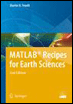
Introducing methods of data analysis in geosciences using MATLAB, this book includes a brief description of each method and numerous examples demonstrating how MATLAB can be used on data sets from earth sciences.
 TABLE OF CONTENTS
 Most data in earth sciences are spatially distributed, either as vector data, (points, lines, polygons) or as raster data (gridded topography). Vector data are generated by digitizing map objects such as drainage networks or outlines of lithologic units. Raster data can be obtained directly from a satellite sensor output, but in most cases grid data can be interpolated from irregularly-distributed samples from the field ( gridding).
The following chapter introduces the use of vector data by using coastline data as an example (Chapter 7.2). Subsequently, the acquisition and handling of raster data is illustrated with help of digital topography data (Chapters 7.3 to 7.5). The availability and use of digital elevation data has increased considerably since the early 90 s. With 5 arc minutes resolution, the ETOPO5 was one of the first data sets for topography and bathymetry. In October 2001, it was replaced by the ETOPO2 that has a resolution of 2 arc minutes. In addition, there is a data set for topography called GTOPO30 completed in 1996 that has a horizontal grid spacing of 30 arc seconds (approximately 1 km). Most recently, the 30 and 90 m resolution data from the Shuttle Radar Topography Mission (SRTM) have replaced the older data sets in most scientific studies.
The second part of the chapter deals with surface estimates from irregularspaced data (Chapters 7.6 to 7.9). In earth sciences, most data are collected in an irregular pattern. Access to sample rocks is often restricted to natural...