MATLAB Recipes for Earth Sciences
Introducing methods of data analysis in geosciences using MATLAB, this book includes a brief description of each method and numerous examples demonstrating how MATLAB can be used on data sets from earth sciences.
 TABLE OF CONTENTS
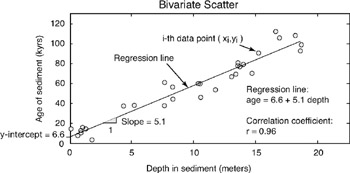
 Bivariate analysis aims to understand the relationship between two variables x and y. Examples are the length and the width of a fossil, the sodium and potassium content of volcanic glass or the organic matter content along a sediment core. When the two variables are measured on the same object, x is usually identified as the independent variable, whereas y is the dependent variable. If both variables were generated in an experiment, the variable manipulated by the experimentalist is described as the independent variable. In some cases, both variables are not manipulated and therefore independent. The methods of bivariate statistics help to describe the strength of the relationship between the two variables, either by a single parameter such as Pearson's correlation coefficient for linear relationships or by an equation obtained by regression analysis (Fig 4.1). The equation describing the relationship between x and y can be used to predict the y-response from arbitrary x's within the range of original data values used for regression. This is of particular importance if one of the two parameters is difficult to measure. In this case, the relationship between the two variables is first determined by regression analysis on a small training set of data. Then the regression equation is used to calculate this parameter from the first variable.