MATLAB Recipes for Earth Sciences
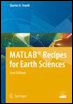
Introducing methods of data analysis in geosciences using MATLAB, this book includes a brief description of each method and numerous examples demonstrating how MATLAB can be used on data sets from earth sciences.
 TABLE OF CONTENTS
 Earth sciences include all disciplines that are related to our planet Earth. Earth scientists make observations and gather data, they formulate and test hypotheses on the forces that have operated in a certain region in order to create its structure. They also make predictions about future changes of the planet. All these steps in exploring the system Earth include the acquisition and analysis of numerical data. An earth scientist needs a solid knowledge in statistical and numerical methods to analyze these data, as well as the ability to use suitable software packages on a computer.
This book introduces some of the most important methods of data analysis in earth sciences by means of MATLAB examples. The examples can be used as recipes for the analysis of the reader's real data after learning their application on synthetic data. The introductory Chapter 1 deals with data acquisition (Chapter 1.2), the expected data types (Chapter 1.3) and the suitable methods for analyzing data in the field of earth sciences (Chapter 1.4). Therefore, we first explore the characteristics of a typical data set. Subsequently, we proceed to investigate the various ways of analyzing data with MATLAB.
Data sets in earth sciences have a very limited sample size. They also contain a significant amount of uncertainties. Such data sets are typically used to describe rather large natural phenomena such as a granite body, a large landslide or a widespread sedimentary unit. The methods described in this book help in finding...