A Practical Approach to Motor Vehicle Engineering and Maintenance, Second Edition
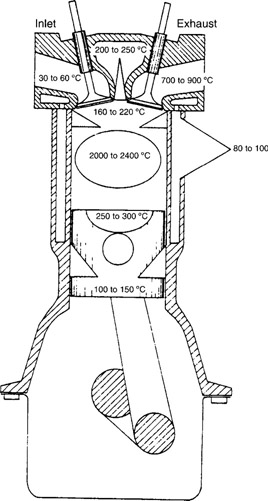
During combustion, when the engine is operating at full throttle, the maximum temperature reached by the burning gases may be as high as 1500 2000 C. The expansion of the gases during the power stroke lowers their temperature considerably, but during the exhaust stroke the gas temperature may still be approximately 800 C. All the engine components with which these hot gases come into contact will absorb heat from them in proportion to:
the gas temperature;
the area of surface exposed to the gas;
the duration of the exposure.
Engine operating temperatures are shown in Fig. 2.1.
For all these reasons the heat will raise the temperature of the engine components. If the temperature of the exhaust gas is above red heat it will be above the melting point of metals such as aluminium from which the pistons are made. Unless steps are taken to reduce these temperatures a number of serious problems could arise.
The combustion chamber walls, piston crown, the upper end of the cylinder and the region of the exhaust port are exposed to the hottest gases and will therefore reach the highest temperatures. This will create distortion causing a leakage of gas, water or oil. It may even cause the valve to burn or the cylinder head to crack and as a consequence there will be a loss of power output.
The oil film will be burnt causing excessive carbon to form. The loss of lubrication of the...