A Practical Approach to Motor Vehicle Engineering and Maintenance, Second Edition
Chapter 11: Ignition Systems

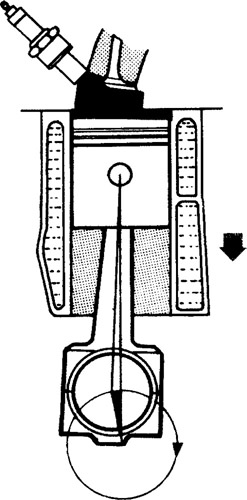
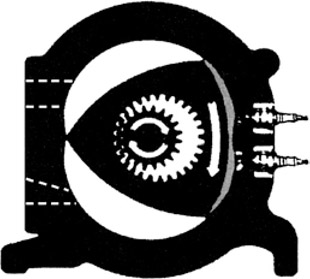
The purpose of the ignition system is to provide a spark to ignite the compressed air fuel mixture in the combustion chamber. The spark must be of sufficient strength to cause ignition and it must occur at the correct time in the cycle of operations. The ignition system is the means by which the 12 volt supply from the vehicle battery is converted into many thousands of volts that are required to produce the spark at the sparking plug, as illustrated by Figs 11.1 and 11.2.


Figure 11.1: Position of the spark in a reciprocating (piston)

Figure 11.2: Position of the spark in a rotary engine

11.1 Producing the high voltage required to cause ignition

Electromagnetism was discussed in the electrical principles section. It is these electro-magnetic principles that are employed in the induction coil type of ignition system.

In this coil there are two windings, a primary winding and a secondary winding. The primary winding consists of a few hundred turns of lacquered copper wire. The secondary winding consists of several thousand turns of thin, lacquered copper wire. The primary winding is wound around the outside of the secondary winding because the heavier current that it carries generates heat which needs to be dissipated. The layers of windings are normally electrically insulated from each other by a layer of insulating material.

In the centre of the secondary winding there is a laminated soft iron core. The purpose of this laminated core is to concentrate the magnetic field that is produced...

UNLIMITED FREE
ACCESS
TO THE WORLD'S BEST IDEAS

SUBMIT
Already a GlobalSpec user? Log in.

This is embarrasing...

An error occurred while processing the form. Please try again in a few minutes.

Customize Your GlobalSpec Experience

Category: Electrical Coil Winding Machines
Finish!
Privacy Policy

This is embarrasing...

An error occurred while processing the form. Please try again in a few minutes.