A Practical Approach to Motor Vehicle Engineering and Maintenance, Second Edition
Modern vehicles are equipped with many electrical and electronic systems, as shown by the list given in Table 10.1.
| Vehicle system | Comment |
|---|---|
| Batteries and charging systems | Alternators, voltage and current control |
| Starter motors | Axial engagement |
| Ignition systems | Distributor type, direct type, distributor-less |
| Engine management | |
| Fuel systems | Single point, multi-point, direct injection |
| Emission control | Oxygen sensor, catalyst, purge canister |
| Diagnostics | EOBD |
| Body electrics | Remote central locking, electrically operated windows, heated screens, screen wash and wipe |
| Security | Immobiliser, anti theft alarm |
| Anti lock brakes, traction control, stability control | CAN systems |
| Lights and signals | Head lights, side and tail, stop lights, hazard lights, interior lights |
We think that it is a good idea to start with the battery. This is where the energy is stored that operates the starter motor and, as vehicle journeys usually begin by starting up the vehicle engine, this seems like a good point at which to start this study of vehicle electrical and electronic systems.
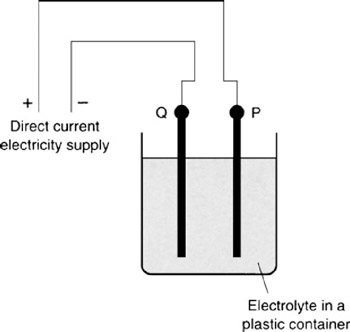
If two suitably supported lead plates are placed in a weak solution of sulphuric acid in water (electrolyte) and the plates connected to a suitable low voltage electricity supply as shown in Fig. 10.1, an electric current will flow through the electrolyte from one plate to the other.
After a few minutes the lead plate P will appear a brownish colour and the plate...