A Practical Approach to Motor Vehicle Engineering and Maintenance, Second Edition
Chapter 8: Steering, Wheels and Tyres

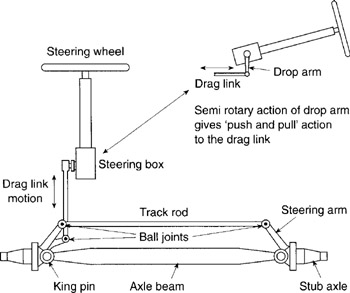
The steering mechanism has two main purposes. It must enable the driver to: easily maintain the straight ahead direction of the vehicle even when bumps are encountered at high speeds; and to change the direction of the vehicle with the minimum amount of effort at the steering wheel. One of the simplest layouts is the beam axle arrangement (Fig. 8.1) as used on large commercial vehicles. This is where the hub pivots or swivels on a king pin (in the case of a car a top and bottom ball-joint) to give the steering action.


Figure 8.1: Layout for beam axle steering system

As can be seen the two stub axles are connected together by two steering arms and a track rod with ball-joints at each end. The steering gearbox converts the rotary movement of the steering wheel into a straight line movement of the steering linkage; it also makes it easier for the driver to steer by giving a gear reduction. The drop arm and drag link connect the steering gear box to the stub axle. The steering arms, track rod and ball joints connect the stub axles together and allow the movement to be transferred from one side of the vehicle to the other as well as providing for the movement of the linkage as the suspension operates.

8.1 Light vehicle steering layouts

To provide means of turning the front wheels of a vehicle left or right would not be too difficult were it not also...

UNLIMITED FREE
ACCESS
TO THE WORLD'S BEST IDEAS

SUBMIT
Already a GlobalSpec user? Log in.

This is embarrasing...

An error occurred while processing the form. Please try again in a few minutes.

Customize Your GlobalSpec Experience

Category: Steering Wheels
Finish!
Privacy Policy

This is embarrasing...

An error occurred while processing the form. Please try again in a few minutes.