Practical Balancing of Rotating Machinery

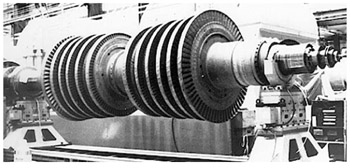
There are a number of classifications of rotors, depending on flexibility, operating speed, and other factors (ISO 5343).
Class 1 is rigid rotors this covers 90% of all applications.
Class 2 is rotors that are not rigid or that have special characteristics of mass distribution but that can be balanced using a modified balancing technique (choice of correction planes is the key here).
Classes 3 and 4 are flexible rotors.
We mention this so that you are made aware that some rotors may have to be balanced at specific speeds, at two speeds, or even when hot. Thermal effects can cause distortion that in turn causes unbalance, which can cause more distortion.
Some call this type of operation 'dynamic straightening' rather than balancing since the aim is to keep the rotor running true by minimizing internal bending stresses of the rotor.
Not a project for a novice.