Practical Balancing of Rotating Machinery

The unbalance mass and radius causes a corresponding shift in the position of the total mass of the rotor.
Unbalance U=M e

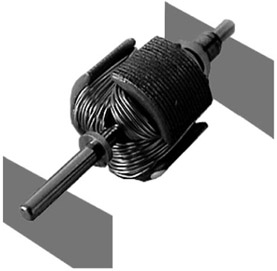
In many cases the unbalance arises from mounting errors such as bore clearance or shaft runout. If the rotor is (say) a flywheel mounted on a motor shaft then there has to be a clearance between the shaft diameter and the flywheel bore. This clearance can cause the flywheel to be mounted off center. This mounting error is an eccentricity (e) and the mass is the rotor mass (M).
Mounting error has the exact same effect as unbalance. The flywheel and the motor may both have been balanced accurately but the mounting error may cause unacceptable vibration.
Individual rotor assemblies may be rejected at final testing due to system vibration. When they are put back on the balancer they test as in tolerance. So why was there excess vibration?
This is a process problem and arises from the lack of understanding of the effect of small amounts of runout, bore clearances and assembly variations. In the realm of balancing an error of 0.001" (0.025 mm) can be a major problem.