Newsletter   FREE GlobalSpec e-Newsletters
Receive the latest news, trends, and technology relevant to your work.
(See Titles)

6.4: Discrete Random Walk Methods for Radiosity

By Philippe Bekaert
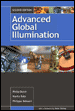
From Advanced Global Illumination, Second Edition
6.4 Discrete Random Walk Methods for Radiosity

In the previous section, a first class of stochastic methods was described for solving the radiosity system of equations (Equation 6.6) or the equivalent power system (Equation 6.8) by means of stochastic variants of well-known iterative solution methods for linear systems, such as the Jacobi iterative method. It was shown that form factor computation and storage is effectively avoided, allowing us to compute radiosity in large models with less computer storage and less computing time than their deterministic counterparts.

This section covers a second class of methods with identical properties. The methods discussed here are based on the concept of a random walk in a so-called discrete state space, explained in Section 6.4.1. Unlike stochastic relaxation methods, random walk methods for linear systems are well covered in Monte Carlo literature [62, 183, 61, 43, 153]. They have been proposed for solving linear systems similar to the radiosity system since the beginning of the 1950s [50, 224]. Their application to radiosity has been proposed in [161, 162].

It turns out that these algorithms are not better than the stochastic Jacobi algorithm of the previous section. We will, however, introduce a number of fundamental concepts that are needed in later sections and chapters, but that are easier to understand first in this context.

6.4.1 Random Walks in a Discrete State Space

Consider the following experiment, involving a set of n urns, labeled i, i = 1 , ..., n.

Copyright A K Peters, Ltd. 2006 under license agreement with Books24x7

Products & Services
Piers and docks are structural walk paths over water. Learn more about Piers and Docks
Industrial storage products include cabinets, containers, coolers, carousels, garages, hoppers, lockers, mezzanines, racks, shelves, shelters, storage tanks, and walk-in enclosures. Learn more about Industrial Storage
Data acquisition input modules accept sensor and other signal output for data acquisition systems. They may include signal conditioning prior to the analog-to-digital conversion stage. Search by Specification | Learn more about Data Acquisition Input Modules
Industrial shelters are buildings or structures that are designed to house and protect instrumentation or personnel. Examples include booths, buildings, canopies, garages, and walk-in enclosures. Search by Specification | Learn more about Industrial Shelters
Darlington transistors (Darlington pairs) are semiconductor devices that combine two bipolar transistors in a single device. They provide high current gain (commonly written ß) and require less space than configurations that use two discrete transistors. Search by Specification | Learn more about Darlington Transistors

Product Announcements
Centryco Inc. - Covers -Linear Rails And Ways
Centryco designs and manufactures way covers in various construction and materials to protect your linear rails and ways from dust to weld spatter. (read more)
PTC - MATHCAD - Mathcad® Datasheet
Mathcad® - Create and Document Critical Engineering Calculations... (read more)
Centryco Inc. - Covers for Welding Applications
Centryco offers a variety of protective covers for welding applications, including walk-on linear rail covers, high temperature fabric covers, copper Centry covers, and welding curtains, among others. (read more)
GE Intelligent Platforms - PACSystems RX3i CPU320
The PACSystems RX3i CPU320 incorporates the Intel 1 GHz processor to provide unprecedented speed and performance. Key features include 64Mbytes of user memory, two built-in communication ports,... (read more)

Topics of Interest
6.5 Photon Density Estimation Methods The algorithms discussed in Sections 6.3 and 6.4 solved the radiosity system of linear equations (Equation 6.6) stochastically. By sampling according to the... (Read More)
Overview When you create an image using ray tracing alone, additional source lights often are required to effectively illuminate the various surfaces in the 3D scene. This is to account for the fact... (Read More)
The first iterative methods used for solving large linear systems were based on relaxation of the coordinates. Beginning with a given approximate solution, these methods modify the components of the... (Read More)
Overview The algorithms discussed in the previous chapter directly compute the intensity of light passing though the pixels of the virtual screen. In contrast, this chapter covers methods that... (Read More)
In this chapter applications of stochastic calculus to population models are given. Diffusion models, Markov Jump process models, age-dependent non-Markov models and stochastic models for competition... (Read More)