Circuit Design with VHDL

In this chapter, we describe the fundamental sections that comprise a piece of VHDL code: LIBRARY declarations, ENTITY, and ARCHITECTURE.
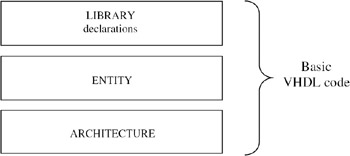
As depicted in figure 2.1, a standalone piece of VHDL code is composed of at least three fundamental sections:
LIBRARY declarations: Contains a list of all libraries to be used in the design. For example: ieee, std, work, etc.
ENTITY: Specifies the I/O pins of the circuit.
ARCHITECTURE: Contains the VHDL code proper, which describes how the circuit should behave (function).
A LIBRARY is a collection of commonly used pieces of code. Placing such pieces inside a library allows them to be reused or shared by other designs.
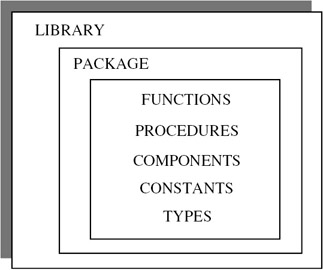
The typical structure of a library is illustrated in figure 2.2. The code is usually written in the form of FUNCTIONS, PROCEDURES, or COMPONENTS, which are placed inside PACKAGES, and then compiled into the destination library.
The fundamental units of VHDL (figure 2.1) will be studied in Part I of the book (up to chapter 9), whereas the library-related sections (figure 2.2) will be seen in Part II (chapters 10 12).
To declare a LIBRARY (that is, to make it visible to the design) two lines of code are needed, one containing the name of the library, and the other a use clause, as shown in the syntax below.
LIBRARY library_name;USE library_name.package_name.package_parts;
At least three...