Elements of 3D Seismology, 2nd Edition

Developed from university courses, this text provides a thorough introduction to the acquisition, processing, and interpretation of 3-D seismic data, theory, techniques, and applications.
 TABLE OF CONTENTS
 Interpretation of 3D seismic data requires an understanding of the migrated data volume and how it can be dissected and interrogated.
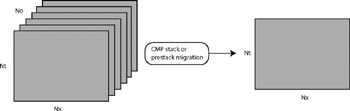
The situation with conventional 2D data is a good place to start. As discussed in chapter 13, 2D prestack data is a volume of data whose dimensions are ( N t, N x, N o) where N t is the number of time samples per trace, N x the number of midpoints, and N o the number of offsets. A seismic amplitude value resides at each point in this array. This 3D object is collapsed to a 2D seismic section by CMP stacking, which is simply summing over offsets after appropriate processing. After poststack migration, the 2D image is ready for interpretation. As we have seen, another path to the migrated image is direct prestack migration, in which the offset summation step is imbedded. In either case, the 2D migrated image is an array with dimensions ( N t, N x). Figure 22.1 illustrates summation through CMP stacking or prestack migration to collapse the offset axis and to create a 2D panel of data.
A 3D prestack data is a hypervolume with dimensions ( N t,N x,N y,N o), where ( N x, N y) are...