Elements of 3D Seismology, 2nd Edition

Developed from university courses, this text provides a thorough introduction to the acquisition, processing, and interpretation of 3-D seismic data, theory, techniques, and applications.
 TABLE OF CONTENTS
 The subject of stratigraphy and sedimentation is concerned with rock features ranging in size from 10 ?5 m (grain size) to 10 5 m (depositional systems). Our interest here is a basic understanding of those stratigraphic features likely to be visible in seismic reflection data. With the bandwidth limitation of surface seismic data, this means features thicker than a few tens of meters and lateral extent of twice that.
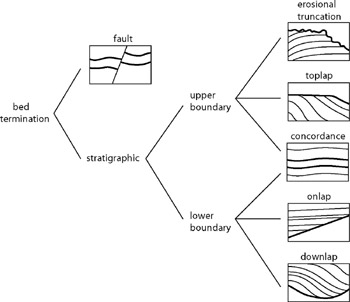
Large-scale stratigraphic features seen in 2D seismic data are evidenced by bed terminations. Stratigraphic bed terminations seen in seismic data occur in only a few ways as illustrated in Figure 24.1. From these basic building blocks, complex geologic relationships can be deduced through the principles of seismic stratigraphy [188] developed in the 1970s and sequence stratigraphy [189] a decade later.
From the mid-1980s on, 3D seismic data afforded a direct map view of stratigraphic features that was never available from even a grid of 2D seismic lines. This revolution is continuing with more and better ways to pull stratigraphic information from 3D seismic data.
[188]Vail, P. R., Mitchum, R. M., and Thompson, S., 1977, "Changes of sea level from coastal onlap: in Payton, C. E., Ed., Seismic Stratigraphy Applications to hydrocarbon exploration," AAPG Memoir 26, 63D81.
[189]Van Wagoner, J. C., H. W. Posamentier, R. M. Mitchum, P. R. Vail,...