SFPE Engineering Guide to Performance-Based Fire Protection Analysis and Design of Buildings

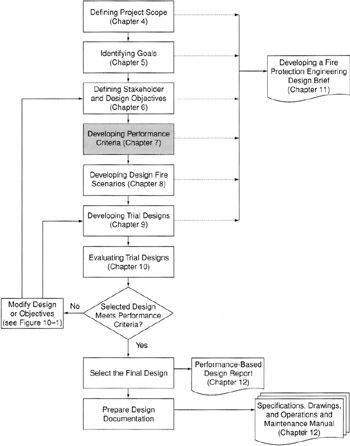
The next step in the performance-based design process requires the selection of performance criteria that will satisfy the design objectives and will be used to evaluate the trial designs. Performance criteria are threshold values, ranges of threshold values, or distributions that are used to develop and evaluate trial designs for a given design situation. Performance criteria might include temperatures of materials, gas temperatures, smoke concentration or obscuration levels, carboxyhemoglobin (COHb) levels, and radiant flux levels. Human response in terms of decision, reaction, and movement times varies over a range of values. To evaluate the adequacy of an egress system design with respect to human exposure criteria, it is necessary to select or assume values for calculation purposes. The rationale for assumptions regarding human behavior should be carefully documented. For example, performance criteria might include values for thermal radiation exposure (kW/m 2) or gas (air) temperature. Other types of performance criteria include concentration of toxic gases (ppm), distance of the smoke layer above the floor (m), visibility (m), or other measurable or calculable parameters. Examples of stakeholder objectives, design objectives, and performance criteria are provided in Appendix B.
More than one performance criterion might be required to adequately evaluate a design objective. In addition, more than one value might be required to adequately describe a performance criterion. For example, essential personnel might be required to delay their evacuation in order to secure an industrial process...